

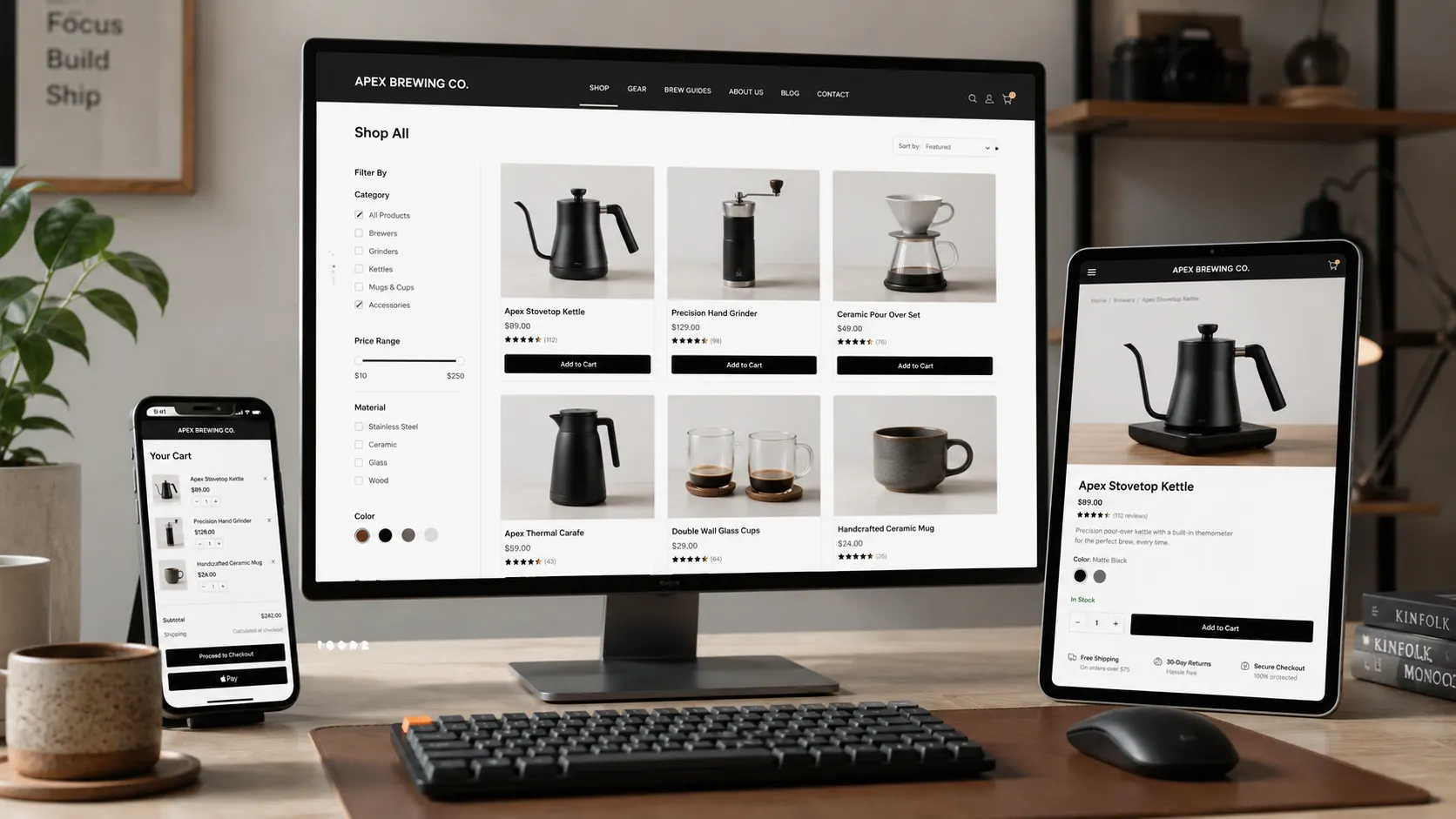
Building an online store is no longer just about publishing product listings on a generic template. Modern consumers expect frictionless browsing, instant load speeds, and intuitive navigation across every screen size. A visual-only layout that fails to prioritize conversion architecture, user psychology, and Core Web Vitals will drain your advertising budget and leave revenue on the table. Whether you plan to scale a direct-to-consumer (D2C) brand or an enterprise catalog, mastering the fundamentals of ecommerce website design is essential for sustainable growth.
What is eCommerce Web Design and Why It Dictates Profitability?
eCommerce web design is the specialized practice of building and styling online storefronts to showcase products, streamline buyer journeys, and optimize checkouts. Unlike standard brochure websites, an eCommerce interface must handle complex data structures: multi-variant inventories, secure payment gateways, dynamic cart states, and real-time shipping APIs.
| Modern eCommerce Core | |
|---|---|
| Visual Experience Layer | Performance & Technical Core |
| • Scrollytelling & 3D Views | • Sub-2s Page Load Time |
| • Responsive Grid Layouts | • Secure Checkout & APIs |
| • Clear Trust & Social Proof | • SEO Schema & Indexation |
The Cost of Poor UX Design
A storefront that lacks a cohesive UX framework creates friction that drives shoppers away. Key factors include:
- Bounce Rate Impact: Over 50% of mobile visitors abandon a site if page elements take more than 3 seconds to render.
- Abandoned Carts: Hidden shipping costs, mandatory account creation, and clunky form fields account for the vast majority of dropped checkouts.
- Perceived Credibility: An outdated layout signals security risks, deterring shoppers from entering payment credentials.
To see modern visual concepts in action, creative platforms like Dribbble eCommerce Showcases offer extensive collections of community UI kits and interactive layouts.
Core Pillars of the Best eCommerce Website Design
Crafting the best ecommerce website design requires aligning aesthetics with conversion rate optimization (CRO).
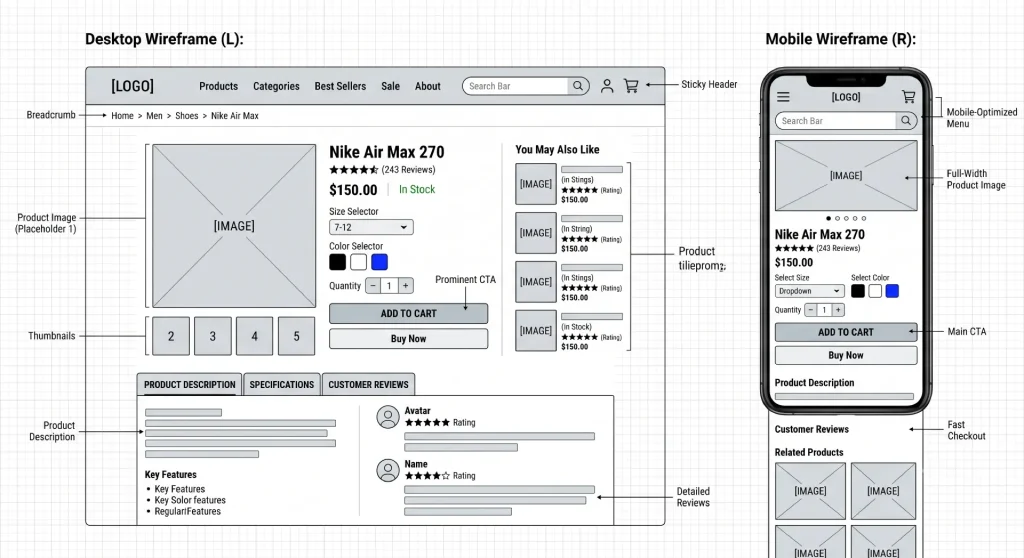
Frictionless Navigation & Search
Shoppers should reach any product in three clicks or fewer. Implement faceted search filtering (by size, color, price, availability) and sticky header menus with prominent search bars powered by predictive auto-suggestions.
Visual Hierarchy & Scrollytelling
Use dynamic grid systems and generous whitespace. High-resolution imagery, 360-degree interactive rotators, and video product demos provide shoppers with the tactile certainty they miss from brick-and-mortar stores.
Mobile-First Responsive Architecture
With mobile commerce accounting for over 70% of digital transactions, desktop-only optimization is obsolete. Sticky “Add to Cart” buttons, thumb-friendly tap targets (minimum 48×48 px), and integrated digital wallets (Apple Pay, Google Pay) ensure smooth one-handed purchasing.
Transparent Social Proof & Trust Badges
Place verified customer reviews, user-generated photos, and security badges near checkout triggers. Clearly display returns, shipping timelines, and customer support channels directly on product detail pages (PDPs).
For curated benchmarks of award-winning interactions, browse through the Awwwards eCommerce Collection.
Platform Breakdown: Shopify vs. WooCommerce
Selecting the right platform dictates your store’s operational overhead, technical agility, and design limits.
                                eCommerce Platform
                                        |
                 +----------------------+----------------------+
                 |                                             |
         Hosted SaaS Model                             Open-Source CMS
         (e.g., Shopify)                              (e.g., WooCommerce)
                 |                                             |
     • Turnkey Infrastructure                      • Complete Code Ownership
     • Fixed Ecosystem Rules                       • Infinite Customization
     • Fast Time-to-Market                         • Custom Server Architecture
| Feature / Metric | Shopify Storefronts | WooCommerce / WordPress |
|---|---|---|
| Ideal Brand Profile | Fast-scaling D2C, multi-channel retail | Content-rich stores, bespoke catalogs, agencies |
| Customization Depth | Liquid template engine + App ecosystem | Open-source PHP, hooks, REST API, full theme control |
| Hosting & Maintenance | Fully managed, serverless scaling | Self-hosted (requires managed WP infrastructure) |
| Transaction Fees | Native Shopify Payments or 0.5%–2.0% gateway fee | Zero core platform transaction surcharges |
| Total Cost of Ownership | Predictable monthly SaaS + paid apps | Variable hosting + custom development & plugin stack |
Choosing Shopify: When Speed and Ecosystem Matter
Hiring experienced shopify website designers allows brands to launch with polished, reliable infrastructure. A dedicated shopify website design company can implement custom Liquid code, headless architectures, and unified checkout experiences tailored for high-volume sales.
Choosing WooCommerce: When Complete Control is Essential
Partnering with a specialized WooCommerce Developer or a full-stack WooCommerce Designer gives you absolute control over your database, server environment, and checkout flows.
A seasoned WooCommerce Website Design Company can optimize database queries, build bespoke plugins, and integrate advanced ERP systems without subscription markups. Discover tailored digital strategies via AR Weberaic Tech eCommerce Services.
Step-by-Step eCommerce Design & Development Workflow
To avoid costly rebuilds, follow an agile, structured process from initial concept to deployment.
[ Research & Wireframing ] ──> [ UI/UX Design System ] ──> [ Platform Build ] ──> [ CRO QA & Launch ]
- Information Architecture & Wireframing:
Map out user journeys, taxonomy, and category hierarchies before designing UI elements. Free design tools like the Figma Community eCommerce Templates can help you rapidly test layout logic. - Design System & High-Fidelity Mockups:
Establish a scalable component library (typography tokens, color palettes, micro-interaction states, button variants). - Core Development & Schema Implementation:
Build responsive templates, integrate payment gateways, and configure Structured Data (Product, AggregateOffer, Review Schema) to maximize rich snippet visibility in search results. - Performance Optimization:
Minify CSS/JS assets, compress product images into next-gen formats (WebP/AVIF), and implement edge caching via CDNs. - Quality Assurance (QA) & User Testing:
Test checkout flows under simulated latency, audit accessibility (WCAG 2.1 AA), and verify cross-browser compatibility across Safari, Chrome, and Firefox.
Explore creative moodboards and visual styles on Behance eCommerce Projects or Pinterest eCommerce Ideas.
Technical SEO and Performance Best Practices
Design choices directly impact search visibility. An eCommerce store must balance high-resolution media with technical SEO standards:
- Core Web Vitals: Keep Largest Contentful Paint (LCP) under 2.5 seconds and Cumulative Layout Shift (CLS) near zero by reserving static dimension boxes for banners and product carousels.
- Faceted Navigation Indexation: Implement canonical tags and robots
noindexdirectives on non-essential filter parameters to preserve crawl budget and prevent duplicate content penalties. - Breadcrumb Navigation: Implement hierarchical breadcrumbs formatted with JSON-LD markup to aid site crawlers and improve search result navigation.
Final Thoughts
A successful online store balances striking visual design with functional speed, clear navigation, and a frictionless checkout process. Choosing between platforms like Shopify or WooCommerce depends on your operational needs, development resources, and customization goals. By focusing on mobile responsiveness, fast load times, and structured trust signals, your eCommerce design becomes an active driver of continuous revenue.
Explore custom storefront builds and performance audits at AR Weberaic Tech.